

Every year, China’s National Day Golden Week brings one of the most predictable yet consistently underestimated disruptions to global supply chains.
The holiday itself runs from 1 to 7 October 2026. But for Australian importers, the impact starts well before that and continues well after factories reopen.
At plane 2 sea, we work with businesses every year to help them plan around Golden Week rather than react to it. This newsletter is designed to give you everything you need to do the same.
WHAT IS GOLDEN WEEK AND WHY DOES IT MATTER?
China’s National Day Golden Week is one of the country’s two major national holiday periods and one of the largest annual human migrations on the planet. Workers across manufacturing, warehousing, logistics, and freight operations travel home to celebrate with their families, and the country essentially pauses for a week.

Image source: TripSavvy
For businesses that source products from China, this creates a predictable but very real pressure point in the supply chain. The challenge is not just the seven days of holiday itself. It is everything that happens in the weeks before and after.
THE GOLDEN WEEK TIMELINE: WHAT ACTUALLY HAPPENS
Understanding the full impact of Golden Week means looking at three distinct phases, not just the holiday dates.
Phase 1: The Pre-Holiday Rush (Mid-September to 30 September)
In the weeks leading up to Golden Week, factories and suppliers work to clear orders before they close. This sounds helpful but it creates significant pressure on freight capacity.
Exporters rush to get cargo to port before cut-off dates. Vessel space tightens as demand surges. Port congestion increases as terminals handle a higher than normal volume of cargo. Freight rates often rise as space becomes limited. Receival cut-offs at some terminals are brought forward to manage the surge.
If you have not locked in your bookings before this phase begins, you may find yourself without vessel space or facing significantly higher rates.
Phase 2: The Holiday (1 to 7 October)
During Golden Week itself, most factories, warehouses, freight forwarders, customs brokers, and inland transport operators in China are either fully closed or operating with a minimal skeleton crew.
This means no new production, no warehouse movements, no new bookings being processed, and very slow communication from suppliers and freight contacts. If something goes wrong with a shipment during this week, resolution will almost certainly wait until after the holiday.
Phase 3: The Post-Holiday Backlog (8 October onwards)
This is the phase that catches most importers off guard.
When China comes back online after Golden Week, thousands of shipments that were held during the holiday are released at the same time. Factories restart production but face their own backlogs of orders. Port terminals deal with a sudden surge of cargo. Vessels bunch as schedules catch up. Transit times extend beyond normal even after operations resume.
The post-holiday backlog can affect schedule reliability for two to four weeks after Golden Week ends. This means that even if your cargo was not directly delayed by the holiday, it may still experience delays in October and early November due to the ripple effects across the supply chain.
HOW GOLDEN WEEK AFFECTS MORE THAN JUST CHINA
It is important to understand that the impact of Golden Week is not contained to China alone. Because so much global cargo moves through Chinese ports and connects with transhipment hubs across Asia, the disruption flows through to other trade lanes as well.
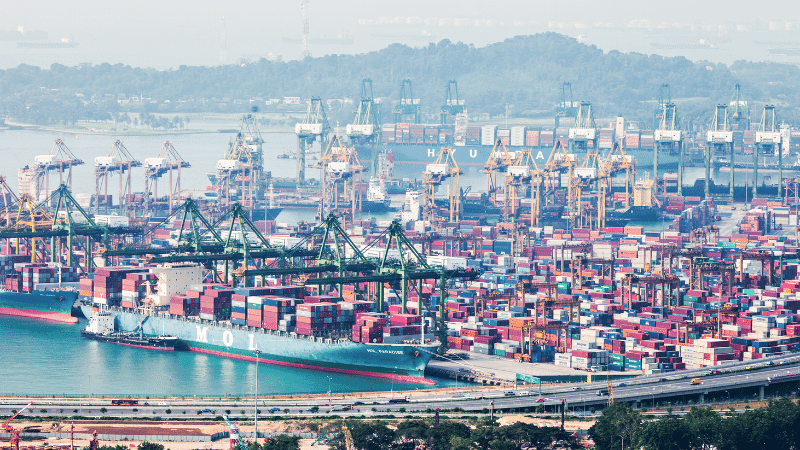
Image source: Beacon
Ports in Singapore, Hong Kong, and across Southeast Asia that handle transhipment cargo from China also experience congestion and schedule pressure during and after Golden Week. Connecting services to Australia can be affected even when the first leg of the journey does not involve China directly.
If your supply chain touches China at any point, including transhipment, Golden Week is relevant to your planning.
FREIGHT RATES AND CAPACITY: WHAT TO EXPECT
Golden Week creates a predictable pattern in freight rates and vessel capacity that plays out similarly every year.
In the weeks before Golden Week, rates tend to rise as demand for vessel space increases ahead of the holiday. Carriers may introduce peak season surcharges during this period. After the holiday, rates can remain elevated as the backlog of cargo works through the system and vessel schedules normalise.
The importers who secure their bookings early, before the pre-holiday rush intensifies, are the ones who get the best rates and the most reliable space. Waiting until late September significantly limits your options.
YOUR GOLDEN WEEK PREPARATION CHECKLIST
Here is what we recommend every importer with China-sourced goods does right now:
Review your October and November order schedule. Identify any shipments that are planned to move during or immediately after Golden Week and flag them for priority attention.
Talk to your suppliers now. Confirm their closing dates, last production dates before the holiday, and when they expect to reopen. Do not assume the official holiday dates reflect your specific supplier’s schedule.
Lock in your freight bookings early. Speak to your freight forwarder about securing vessel space before the pre-holiday rush drives up rates and reduces availability.
Build buffer time into your delivery commitments. If you have customers expecting deliveries in October or early November, communicate early about potential delays rather than managing expectations after the fact.
Plan your inventory. If Golden Week disruption would impact your ability to meet customer demand, consider whether bringing forward some orders makes sense for your business.
Stay in regular contact with your freight forwarder. During periods like Golden Week, proactive communication from your logistics partner makes a significant difference. At plane 2 sea, we keep clients informed as conditions develop.
HOW plane 2 sea SUPPORTS CLIENTS THROUGH GOLDEN WEEK
plane 2 sea | China’s Golden week
At plane 2 sea, we have been helping Australian businesses navigate Golden Week and other major holiday disruptions for over 15 years.
During this period our team actively monitors vessel schedules and capacity across affected trade lanes, works closely with our agents and shipping line contacts in China to secure space and manage bookings, keeps clients informed of any changes to ETDs and ETAs as they occur, and explores alternative routing options where standard services are impacted.
We understand that the weeks around Golden Week require more communication, more proactive planning, and more flexibility than a standard freight period. That is exactly what our team is here to provide.
If you have shipments planned for October or November and you want to make sure your supply chain is as prepared as it can be, get in touch with us now. The earlier we start the planning conversation, the more options we have available.
Phone : (02) 9525 9922
Email : carolina@plane2sea.com.au
Website : www.plane2sea.com.au
Moving the world 2 you.
#plane2sea #GoldenWeek #ChinaNationalDay #FreightForwarding #SupplyChain #ImportExport #AustralianBusiness #GlobalLogistics #HolidayShipping #LogisticsInsights